The Evershift
Framework
This framework is for video game developers to enable them to start thinking about what an adaptable and personalised game might look like in the future.
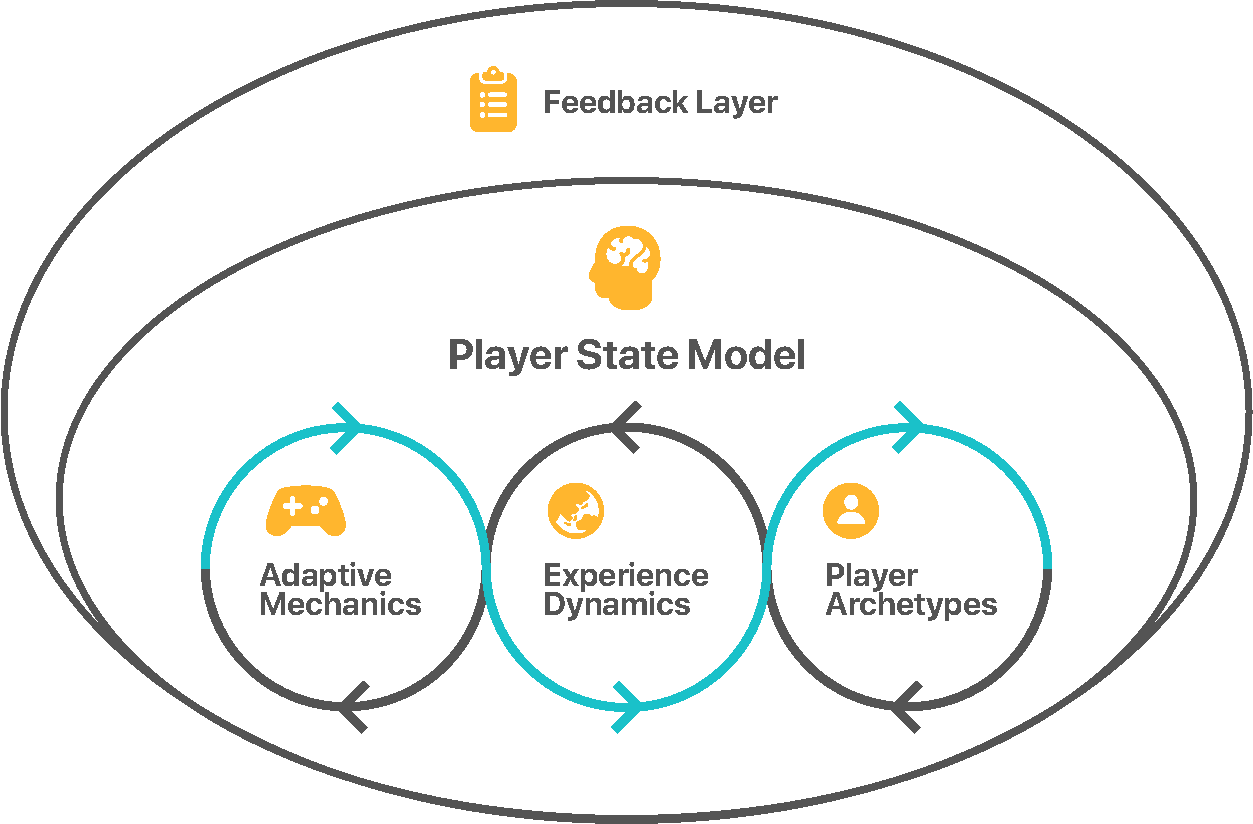
Player State Model
Building a real-time player state model of the player’s emotional and cognitive state.
Learn More
Adaptive Mechanics
Using real-time player state to dynamically adjust game systems to improve wellbeing.
Learn More
Experience Dynamics
Structure core loops and world design to nurture emotional goals, not just engagement.
Learn More
Player Layer - The Game Listens
The player layer is about understanding the player , capturing emotional, cognitive, or physiological data (like stress levels, play-style, or mood) to create a real-time snapshot of their state.
Biometrics
Heart rate (HRV), EEG, skin conductance
Behaviour
Input patterns, choice timing, pause frequency
Player Preference
Onboarding surveys, in-game check-ins
These are used to create a player state model for each individual player, which is constantly evolving based on the above parameters. This player state model is used for both the adaptive mechanics and experience dynamics.
Player Archetypes
The player archetypes are used to inform the player state model to create a deeper understanding of the player. Players are never a fixed archetype, like the player layer the archetypes are a dynamic value that could change over time based on player behaviour and preferences.

Achievers
I want to achieve something
Driven by progress and completion, Achievers enjoy setting goals, earning rewards, and mastering challenges.

Explorers
I want to immerse myself
Explorers love freedom and discovery, finding joy in hidden paths, lore, and understanding complex worlds.

The Competitive
I want to win
Competitive players thrive on challenge and recognition, aiming to win, rank high, and outperform others.
Feedback Layer
The Feedback Layer is where the game communicates back to the player what it has noticed, how it responded, and what that means. It closes the loop between player state, game adaptation, and emotional insight. The core functions are below :
Acknowledge
I saw how you played and how you felt.
Reflect
Here’s how your journey unfolded emotionally
Guide
Here’s what you might need next. Rest or a challenge.
Empower
You’re making progress. Not just in game, but in your mindset.
Player Archetypes
Different player engagement types to dynamically tailor the game experience.
Learn More
Feedback Layer
Defining clear pathways to help players reflect on how the game is affecting them
Learn More
How to Use
A simple step by step guide on how to implement this framework in a video game.
Learn More
Adaptive Mechanics - The Game Responds
As part of this layer, the game should explore how to sense the players emotion and physical state and dynamically adjust the experience by creating adaptive game mechanics that work in real time.
Action / FPS
Narrative
Puzzle
RPG
Casual / Cozy
🎮
What should adapt
Micro-pacing: adjust enemy spawn rate, hit feedback, weapon handling. Difficulty should dynamically adjust based on player performance.
How to Use
As part of this layer, the game should explore how to sense the players emotion and physical state and dynamically adjust the experience by creating adaptive game mechanics that work in real time.
Experience Dynamics - The Game Guides
Experience Architecture is the intentional design of a game’s emotional pacing and structure, shaping how players feel as they move through the game. It involves planning moments of tension, calm, reflection, and resolution, using narrative, environment, and game systems to guide the player on a meaningful emotional journey.
Here are some wellbeing pillars to keep in mind.
Action / FPS
Narrative
Puzzle
RPG
Casual / Cozy
🎮
Core Emphasis
Safe rooms, cool-down phases, narrative breaks between combat zones